Jump to content

Quartz Countertops in Riverside, CA

Quartz countertops in Riverside: how engineered stone handles heat and sun, the edge profiles worth paying for, and care that keeps the finish even.

What We Cover

Quartz Countertops for Riverside Homes

Quartz countertops are engineered stone: crushed natural quartz bound with resin and pigment, pressed into slabs and polished. The result is a surface with consistent colour, very low porosity and no need for sealing, which is why it has become the default choice in many Riverside remodels. It is not the answer to everything, though. The resin that makes quartz easy to live with also sets its limits, especially with heat and direct sunlight. This site explains what quartz does well, where it struggles and how to plan an install around it.

Heat Is the Real Limit

The binder in quartz can scorch or discolour when a very hot pan is set straight onto it, and the damage is permanent. A trivet next to the range solves the problem, and it is worth building the habit before the new top arrives. Heat also matters near appliances that vent warm air, such as a slide in range with a rear vent. Leave the clearances the manufacturer specifies, and ask the fabricator whether a heat shield strip is recommended for your model.

Sunlight and Outdoor Kitchens

Most quartz is intended for indoor use. Long exposure to direct ultraviolet light can yellow or fade the resin, which matters in a city with as many sunny days as Riverside. A kitchen window that throws strong afternoon light onto one section of counter is usually fine, but an outdoor kitchen or a patio bar should use a product rated for exterior use, or a natural stone or porcelain slab instead.

Edges and Finishes Worth Paying For

Because quartz is uniform, the edge profile and finish carry more of the design weight than they do on a busy granite. An eased or small beveled edge is the most durable. Mitred edges that make a slab look thicker are popular on islands and need careful fabrication so the joint stays tight. Honed and textured finishes hide fingerprints better than high polish but can hold marks from metal pots, so ask to see a sample that has been used.

Keeping Quartz Looking Even

Day to day care is simple: warm water, mild dish soap and a soft cloth. Avoid harsh alkaline cleaners, oven cleaner and bleach, which can dull the resin. Hard water marks around the faucet wipe away easily when they are fresh. Because quartz does not absorb liquids the way natural stone can, spills of wine, coffee or oil are rarely a problem so long as they are not left for days.

Latest Guides

Quartz Countertops in Riverside: Sun Yellowing, Scorch Marks and Heat Cracks
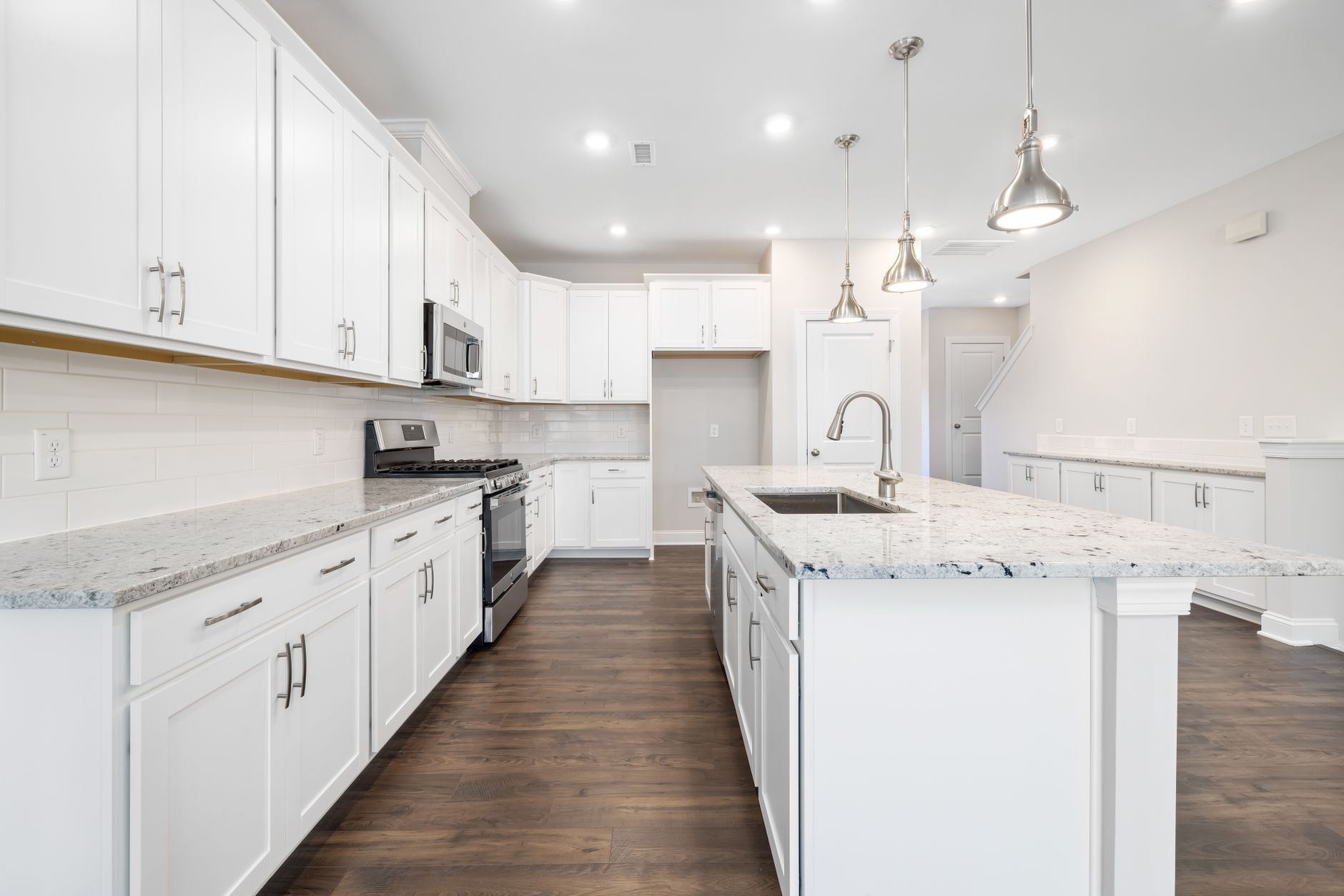
Spacious modern kitchen featuring white cabinets, marble countertops, and an island with stainless steel in Riverside, CA

Why Quartz Reacts to Riverside Sun and Heat

Quartz countertops yellow, scorch and crack for three separate reasons, and only one of them is really about the stone. Engineered quartz is crushed natural quartz bound in a polymer resin, and the resin is the part that reacts to ultraviolet light, to concentrated heat and to harsh chemicals. The mineral content stays stable; the binder around it does not. In a Riverside kitchen with a west or south facing window, a garden window or a wide sliding door, that binder absorbs far more light than it would in a shaded room, and knowing which failure you are looking at tells you whether to change the light, change a habit or call a fabricator.

The binder is the layer that changes

Colour and surface sheen live in the resin, not in the quartz grains. Sunlight breaks polymer chains down slowly, so the change is rarely dramatic in one season. It arrives over years as a faint yellow cast, a slightly chalky look or a loss of depth in the pattern. White, cream and pale grey slabs show it first because there is little pigment to mask the shift. Darker counters change as well, but the eye reads the difference as normal variation for much longer.

How to check a counter you already own

Clear the surface and compare an area that sits in direct sun with a stretch that stays shaded beneath the upper cabinets. Look along the counter at a low angle rather than straight down, because tone shifts read better in raking light. A yellow band following the window line, or a rectangle of different colour where a crock has sat untouched for years, is the ordinary first sign. Households in older Riverside neighborhoods often find the same effect where a bread board has covered one section and left the rest exposed.

Keeping Sunlight Off the Surface

Prevention is mostly about the window, not the counter. Riverside runs long, hot, dry summers with strong sun across much of the year, and the kitchens that suffer are the ones with unobstructed west or south glass. Where the layout allows, close shades or blinds during the harshest afternoon hours. A UV filtering window film is a quieter option that keeps the view and cuts a meaningful share of the ultraviolet load. Either measure protects the resin without changing how the kitchen works.

Pick a colour knowing the room is bright

If a light counter is the goal in a sunny kitchen, ask the supplier which of their lines they recommend for high light rooms. Ultraviolet resistance varies by product and by colour, so a general answer about quartz is not good enough. Before committing, take a sample home and leave it in the sunniest window for several weeks. Keep a second sample of the same colour in a drawer as a control. Compare the two at the end, in the same light, and you will have a real answer instead of a sales promise.

Small habits that add up

Rotate the objects that live on the counter: the knife block, the coffee maker, the fruit bowl. A counter that is uniformly exposed ages evenly, while one with permanent shadows develops visible outlines. None of this stops the underlying chemistry, but it keeps the difference from becoming a pattern of squares and circles nobody can ignore.

Scorch Marks and Thermal Cracks

Quartz is not heatproof. A pan straight off the burner or out of a four hundred degree oven can scorch the resin in seconds, leaving a permanent white, yellow or brown mark that no polish will fully lift. The same sudden, localised heat can also shock the slab into a crack. This is the failure owners most often mistake for a manufacturing defect, and it is almost always avoidable with one piece of equipment: a trivet, used every single time, without exception.

Appliances that run for hours

Slow cookers, air fryers, electric griddles, roasters and bread machines all push heat downward for long stretches. A warm base that feels harmless after twenty minutes can discolour the resin after three hours. Set these appliances on a trivet, a heat resistant board or a folded towel over a cutting board. Move them off the counter entirely for a long cook if there is room elsewhere. The damage from this kind of gentle, sustained heat is slow and cumulative, which makes it easy to miss until a pale ring appears.

Cutouts, seams and the cooking zone

Thermal cracks usually begin where the slab is narrowest, and that means the rim around a cooktop or sink cutout. Ask the fabricator for rounded inside corners on every cutout, because a sharp inside corner concentrates stress and gives a crack a place to start. Follow the range maker's instructions for cutout size and clearance as well; a unit wedged tight against the stone pushes more heat into it. Where the layout allows, keep seams out of the cooking zone, since a seam beside a burner faces both heat and movement.

Outdoor Kitchens and Covered Patios

Standard indoor quartz is generally not intended for outdoor kitchens, barbecue islands or open patios, and most manufacturers exclude outdoor installation from their warranty. Riverside backyards are hard on any surface, with intense summer sun and dry air, and a slab rated for a shaded interior has no business taking that exposure. If a backyard kitchen is the plan, look at granite, porcelain or sintered stone, or a product the maker specifically rates for exterior use.

A covered patio is not automatically safe either. Reflected light off paving and low afternoon sun still reach a bar top or pass through counter, so treat any semi outdoor surface as outdoor exposure unless the product is rated for it. The warranty language is the place to check, not the showroom lighting.

Support and Movement, the Cracks Blamed on Heat

Not every crack comes from a hot pan. Uneven support is a common cause, particularly in older Riverside homes where floors and cabinets have settled out of level. The installer should shim and level the cabinet tops so the slab rests evenly along its full length. Check that the stone is properly supported across the dishwasher opening and under any seating overhang, and follow the manufacturer's guidance on when an overhang needs brackets or corbels.

Southern California also brings ground movement and seasonal swings in house framing. A small gap at the wall, filled with flexible silicone caulk rather than rigid grout, lets the counter and the house move independently instead of stressing the stone. If a crack appears nowhere near a heat source, support and movement deserve the first look.

Cleaning Without Attacking the Resin

Quartz is nonporous and does not need sealing. Products made for natural stone usually leave a film that looks streaky or cloudy, so skip them. Riverside water is hard, and mineral spots form around faucets and wherever a wet glass has stood; wipe them with warm water and mild dish soap, or a cleaner labeled safe for quartz. Avoid oven cleaner, paint stripper, nail polish remover left to sit, concentrated bleach and strong high pH degreasers, all of which attack the resin. Rinse immediately if any of them spill.

Dull or hazy patches are usually cleaner residue that was never rinsed away, not wear. Rinse with clean water and buff dry before assuming the surface is damaged. Santa Ana winds push fine grit indoors, and while quartz resists scratching well, wipe the surface before sliding a heavy appliance or a cast iron pan across it.

What the Warranty Really Covers

Read the warranty before buying, and read the exclusions rather than the headline. Heat damage, ultraviolet discoloration, outdoor use and chemical damage are commonly excluded, which makes the real protection narrower than many owners expect. Ask the supplier directly how their product behaves in a bright room, and get the answer in writing if a particular line is being recommended for a sunny kitchen. A counter that is chosen for the light it will actually live in, triveted without fail and supported evenly has a good chance of looking the same in ten years as it does on installation day.
Custom Countertops in Quartz: Why Lot Numbers Decide Whether Two Slabs Match

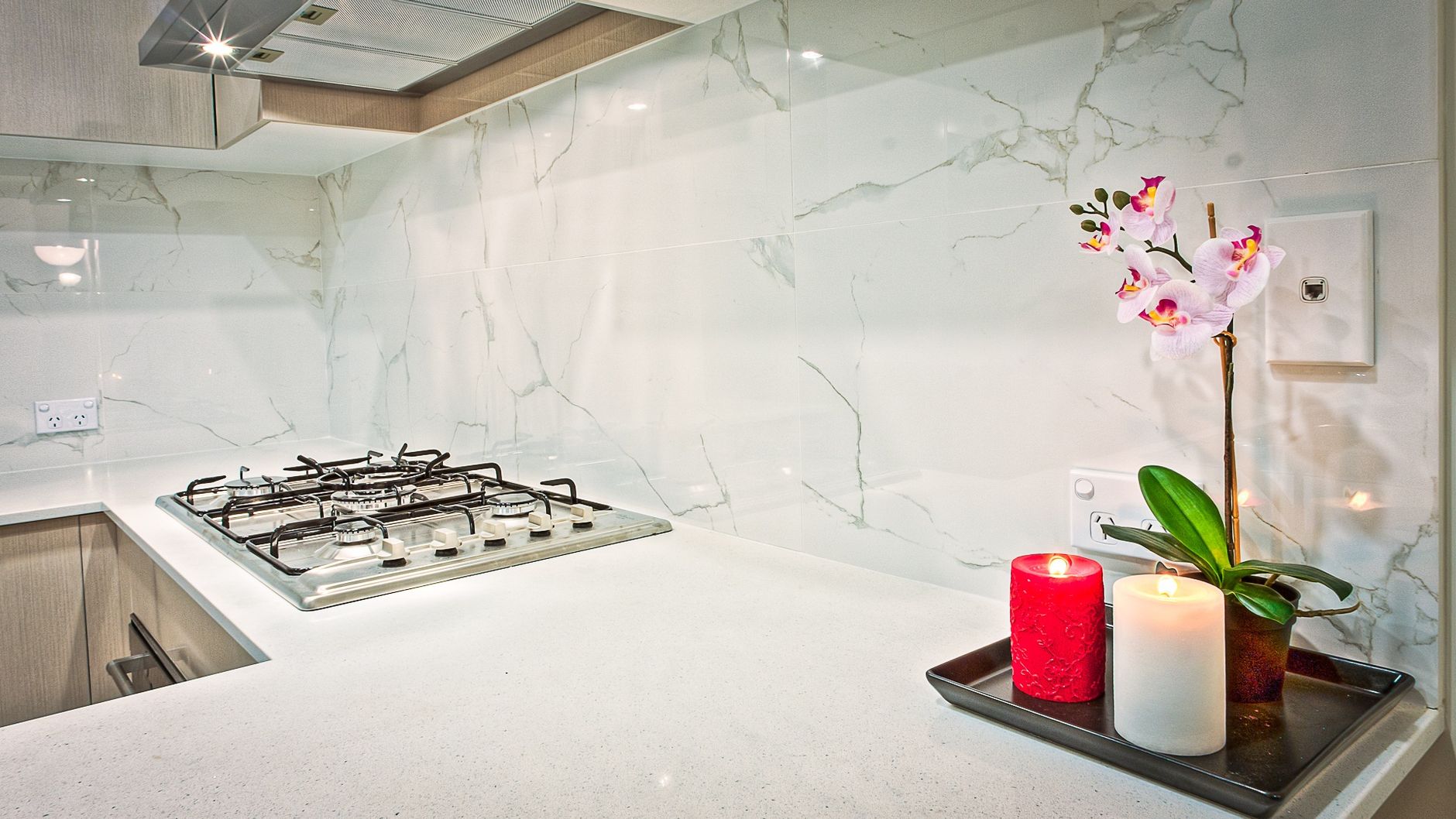
Stylish kitchen interior featuring decorative candles and orchids on a countertop in Riverside, CA

Two slabs lean in the same rack at the same yard, and the label on each carries the same range name and the same product code. Put them face to face and one is slightly warmer than the other, and the dark veining through one is a shade heavier. Neither slab is defective and neither is mislabelled. They were made at different times.

Engineered quartz is a manufactured product, so it is natural to assume two slabs of one design are identical the way two screws out of one box are identical. They are not. They are identical within a production run and only approximately alike across production runs, and the thing that tells you which run a slab came from is a number printed on it. That number is the single most useful piece of information on the whole slab, and most homeowners never see it, never ask for it and never write it down.

It matters most in a kitchen that gets extended later. The island that arrives a year after the perimeter, the powder room vanity meant to match the kitchen, the one piece remade after a chip: each of those goes looking for material that may no longer exist in the form it once did. It is worth knowing which engineered ranges a shop fabricates week in and week out before you commit to a colour name, and a plain look at a local shop's own service listing at http://riversidecustomcountertops.com is a reasonable starting point, because a fabricator who handles a range constantly knows how its lots behave and which designs drift the most.

Quartz is made in batches, not in a continuous stream

A quartz slab begins as a dry blend: crushed quartz aggregate in several grain sizes, polyester resin, pigment, and whatever decorative additives a design calls for. The blend is weighed out, mixed, spread into a mould as a loose mat, compacted under vacuum and vibration, cured with heat, then ground to thickness and polished on one face. The whole sequence runs as a campaign. A plant does not make one design continuously. It sets up for a design, runs some number of slabs, and changes over to the next one.

That campaign is the batch, also called the lot. Everything inside it shares one pigment weighing, one resin delivery, one aggregate shipment, one set of press and oven settings and one operator's hand on the veining equipment. Everything in the next campaign shares a different set of all of those. Tolerances are tight and the plant works hard to hit the same target every time, but a target hit twice is not the same as a single pour.

What a lot number is, and where to find it

Manufacturers label slabs, and the label is more informative than it looks. Expect some combination of the design name or code, the thickness, the finish, a slab serial number and a batch or lot identifier. Producers use different words for the same thing: batch, lot, production run, or a date code that encodes the week the slab was pressed. The label is a printed sticker or a stencilled mark, and it sits on the back face or along one edge, because the front has to stay clean.

This is the practical consequence. A slab standing in an A frame rack shows you its face and hides its label, so the number is read by whoever walks behind the rack with a torch, not by the homeowner standing in front of it. If you want it, ask, and ask for a photograph of the label rather than a number read out loud. A single transposed character turns a useful record into a dead end a year later.

The slab label is also normally cut away, because it sits on an area that becomes an offcut. Once fabrication is finished, the number exists only where somebody wrote it down.

Where the drift actually comes from

Between two lots of one design, four things move, and they move independently.

Base tone. Pigment is a small fraction of the mix by weight, and small fractions are where weighing error shows. The shift is usually a fraction of a shade, warmer or cooler, lighter or darker. On a white or an off white it is the easiest thing in the world to see, because the eye has no pattern to be distracted by. On a mid tone speckle it is nearly invisible.

Vein weight and spacing. Veined designs are built by introducing contrasting material into the mat, and how heavily it reads depends on settings, feed rates and in some plants on a person. A later lot can carry veins that are broader, thinner, more frequent or more diffuse. The design is still recognisably itself. It is just drawn with a different pressure.

Aggregate. Crushed quartz is a mined raw material, and a new shipment can be marginally different in grain colour and grain size distribution. On a design where the aggregate is visible this changes the texture of the background slightly.

Gloss. Polishing lines are maintained and consumables wear. Two lots can leave the plant with a measurably different sheen, which is the hardest of the four to notice on a vertical slab and one of the easiest to notice on a horizontal counter.

None of these are failures. Each one sits inside the manufacturer's published tolerance, which is why a slab from a different lot is not a warranty matter and not something a yard will take back. The tolerance is written for a slab judged on its own. It is not written for two pieces meeting at a seam in your kitchen, where the comparison is direct and permanent.

One kitchen, one lot

The rule that follows is short. Every slab for one continuous installation should come from one lot, and that should be written on the order rather than assumed.

A galley kitchen with an island often needs two slabs; a larger kitchen with a long run, a peninsula and a pantry can need four. The pieces that end up adjacent are not the ones you would guess, because a layout nests pieces for yield. Any two slabs in the job can end up meeting at a joint or sitting in one sightline, so the only safe assumption is that all of them have to agree.

This costs nothing at the time. A yard holding six slabs of a popular white usually has them from one or two lots, and reserving three from one of those is an ordinary request made every day. What it cannot be is a late request. Once slabs are allocated to other jobs, the set you wanted is gone, and the honest answer becomes a wait for the next container rather than a swap in the rack.

The three additions that go wrong

An island or a second run added later. This is the most common and the most painful, because an island is a large, isolated, well lit object that people look at from across the room. A new lot on an island beside a perimeter from an old lot is a comparison the eye makes instantly, and there is no fix short of redoing one of them.

A bathroom meant to match. This one is usually fine, and it is worth saying so. A vanity in another room is never seen next to the kitchen, so half a shade of difference is invisible in practice. The phrase to use with yourself is same design rather than same slab. The match only has to be exact where two surfaces are visible at once: a butler pantry, a wet bar, a laundry open to the kitchen.

One piece replaced. A corner chipped badly, a cutout cracked, a section damaged during a later remodel. The replacement has to sit in a run of original pieces, which is the hardest possible test. If the lot is still available this is a straightforward remake. If it is not, the realistic options are a replacement that is slightly off, remaking a larger section so that the difference falls at a natural break like an inside corner, or living with the damage. Homeowners are rarely told that the third option exists and is sometimes the right one.

There is a time dimension nobody warns you about. Lots move through distribution in months, not years, and a design can be revised or discontinued while keeping its name. Two years is long enough for the material in your kitchen to have no current equivalent at all.

Keep the offcuts, and know what they are for

Every job produces waste. The sink cutout, the cooktop cutout, the triangles left after nesting, and often a usable strip the length of the slab. Shops normally keep this material, sell what is big enough as remnants and skip the rest, which is reasonable because storage space is expensive.

Ask for the sink cutout, and for any offcut over a couple of feet long, to come to you. It is your material, and it has three uses. It is a colour reference that ages alongside the installation rather than sitting in a drawer as a factory sample. It is the material a shop can use to patch a chip or build a small filler piece beside a new appliance. And it is what a fabricator holds against a candidate slab years later to answer the only question that matters: does this look like what is already in the room.

Store it flat, off the ground and out of direct sun. On edge against a wall is how offcuts get knocked over and broken.

What to write down

Four lines, kept wherever you keep the house paperwork. The manufacturer and the exact design name and code, including any suffix for thickness and finish. The lot, batch or production code, copied from a photograph of the label. The slab serial numbers allocated to the job. The yard or distributor the material came through, since that is who can say what is left of a lot.

What to ask before the slabs are ordered

Are all the slabs for this job from one lot, and can that go on the order. What is the lot number, and can I have a photograph of the label. Is any part of this kitchen likely to be added to later, and if so should we buy the extra slab now and store it. Does the yard hold more of this lot, and for how long. Do the offcuts come to me.

The third question on that list is the one that changes everything else. Buying a slab you do not need yet feels wasteful, and on a kitchen where an island is already drawn for next year it is the cheapest insurance in the project, because the alternative is paying full price later for material that no longer matches. None of this is exotic. It is a number on a label, a sentence on an order, and a cutout kept in the garage.

Quartz or Granite for a Riverside Kitchen

Choosing between quartz and granite is one of the most common decisions in a Riverside kitchen remodel, and it rarely has a single right answer. Both materials last for years, both are sold in slabs, and both can be fabricated with similar edges and cutouts. They differ in where they come from, how they behave under heat and spills, how they look in daylight, and how they are maintained. This comparison lays those differences out plainly.

Where each material comes from

Granite is quarried natural stone. It forms underground over a very long time and is cut into slabs, then polished at a fabrication shop. Each slab is unique, with its own flecks, veins and color shifts.

Quartz in this context means engineered stone. Crushed natural quartz is bound with resin and pigment, then pressed into slabs. The result is consistent, so a sample you see in a showroom looks very much like the slab that arrives. Many quartz designs imitate marble or concrete, and some include small sparkling particles.

A third natural option, quartzite, is often confused with quartz because of the name. Quartzite is quarried stone that is harder than most granite and often has a soft, marble-like pattern. It is a different material from engineered quartz and is worth considering if you want a natural look with strong durability.

Appearance in a Riverside home

Riverside kitchens receive plenty of bright light for much of the year, since summers are hot and dry. Strong sun through a window or sliding door changes how a stone looks. Polished granite can glint, and a dark slab can appear almost black in shade and show gold or green flecks in the sun. Quartz tends to look even, which can be an advantage if the cabinets and flooring already have a lot of pattern.

Homes near downtown and in older streets near Mount Rubidoux often lean toward warm, traditional finishes, and a veined granite or soft quartzite can fit the character of such a house. Newer homes in La Sierra or Orangecrest often favor clean, light surfaces, where a white or gray quartz with subtle movement is a common choice. These are tendencies, not rules.

Heat

Granite generally tolerates heat from a hot pan better than quartz does. The stone itself is formed under extreme conditions and does not scorch under normal cooking. Even so, a trivet is wise, because a sudden temperature change can stress the surface or a seam.

Quartz contains resin, and resin can discolor or mark under a very hot pan. Most installers recommend trivets or hot pads with quartz at all times. If you cook with heavy cast iron or move pots directly from burner to counter, this difference matters.

Stains and sealing

Granite is slightly porous. Many installers apply a sealer after installation, and the sealer is renewed from time to time. Dark granite shows stains less than light granite, and a well-sealed surface resists oil, wine and coffee for a good while. If a spill sits for a long time on an unsealed area, a stain can set.

Quartz is nonporous, so it does not need sealing. Spills wipe away readily, which suits busy households. Some strong chemicals and abrasive pads can dull the surface, so a mild cleaner and a soft cloth are the normal routine.

Scratches and chips

Granite is hard and resists scratching from a knife in everyday use, although you should still use a cutting board to protect both the stone and your blade. Edges and corners can chip if struck hard, particularly on a sharp profile. A rounded or eased edge is more forgiving.

Quartz is also quite resistant to scratching, though it is not scratch proof. Edges can chip, and chips can be repaired by a skilled fabricator in either material.

Pattern, color and consistency

Here the two materials diverge most.

  • **Granite** offers natural variety. If you love a slab with dramatic movement, it is hard to match with engineered stone. The downside is that the slab you tag must be the one used, since a sample can differ from the actual piece.
  • **Quartz** offers predictability. Two slabs for a large island will match closely, which simplifies seams and layout. The tradeoff is that patterns repeat, and veining can look slightly uniform to a trained eye.

For a long run of countertop with a seam, quartz usually makes pattern matching easier. For a small kitchen, a single slab of granite can be a beautiful focal point.

Fabrication and installation

Both materials follow a similar process. A fabricator templates the cabinet tops, cuts the slabs to the template, shapes the edges, cuts openings for the sink and cooktop, and installs the pieces with adhesive. Seams are bonded and polished. Undermount sinks work well with both. Overhangs for seating need support, and long unsupported spans on a thin slab can crack, so ask about brackets.

Quartz slabs are often uniform in thickness and quite rigid. Granite can be a bit more variable, and fissures in a slab can limit where cutouts and seams may go. A good fabricator will study the slab before marking it.

Outdoor and sun exposure

If a countertop is near a sliding glass door that receives hot, direct afternoon sun, or if you are planning an outdoor kitchen, material choice matters. Granite is commonly used outdoors because it handles weather and ultraviolet light well. Quartz is generally intended for indoor use, since resins can fade or discolor in prolonged direct sun. Riverside's long dry summers make this a real consideration for patios and for kitchens with large west-facing windows.

Daily upkeep compared

  • **Granite:** wipe with mild soap, reseal as the installer advises, avoid acidic cleaners on an unsealed stone.
  • **Quartz:** wipe with mild soap, avoid abrasive scrubbers, protect from very hot pans.

Neither needs special products beyond what a fabricator recommends. Following their care sheet is usually the best guide.

Resale and buyer perception

Buyers in the Inland Empire are used to seeing both materials. Granite once read as the premium choice and now reads as classic, while quartz reads as modern and low maintenance. A neutral color in either material tends to appeal broadly, and a very bold choice can narrow the audience. If you plan to stay in the house for years, choose what you enjoy. If you plan to sell soon, a neutral pattern is a safer bet.

A simple way to decide

Ask yourself a few questions:

  • Do you want a one of a kind pattern, or a consistent look?
  • Do you cook with hot pans directly on the counter?
  • Are you comfortable resealing a surface now and then?
  • Is there strong direct sun on the countertop?
  • Will the kitchen have a long run that needs a seam?
  • Do you prefer the feel of natural stone?

If most of your answers lean toward natural variety and heat tolerance, granite or quartzite is likely to suit you. If they lean toward ease of care and uniformity, quartz is likely a better match.

See the real slabs

Whatever you lean toward, the final step is the same. Visit a slab yard in the Riverside area, look at full slabs next to your cabinet and floor samples, and ask the fabricator which slab would be used for each piece of your layout. Photos and small samples help narrow choices, but only a full slab shows how the material will behave across a whole kitchen. Once you have compared both under real light, the decision usually becomes clear.